Overview
As trade between the United Kingdom and Saudi Arabia continues to grow, businesses need reliable freight solutions to keep goods moving efficiently. From industrial equipment and automotive parts to pharmaceuticals, retail products and project cargo, choosing the right shipping route can significantly impact transit times, costs and supply chain performance.
According to the UK Department for Business and Trade, Saudi Arabia remains one of the UK's largest trading partners in the Middle East, with bilateral trade exceeding £13 billion in the year ending Q4 2025. At the same time, Saudi Arabia's Vision 2030 programme continues to increase demand for imported machinery, construction materials, healthcare products and manufacturing equipment.
Whether you're exporting full container loads (FCL), less-than-container loads (LCL) or urgent air cargo, understanding the available freight routes helps you make informed logistics decisions. If you are new to international logistics, start with what a freight forwarder actually does and our broader international shipping process guide.
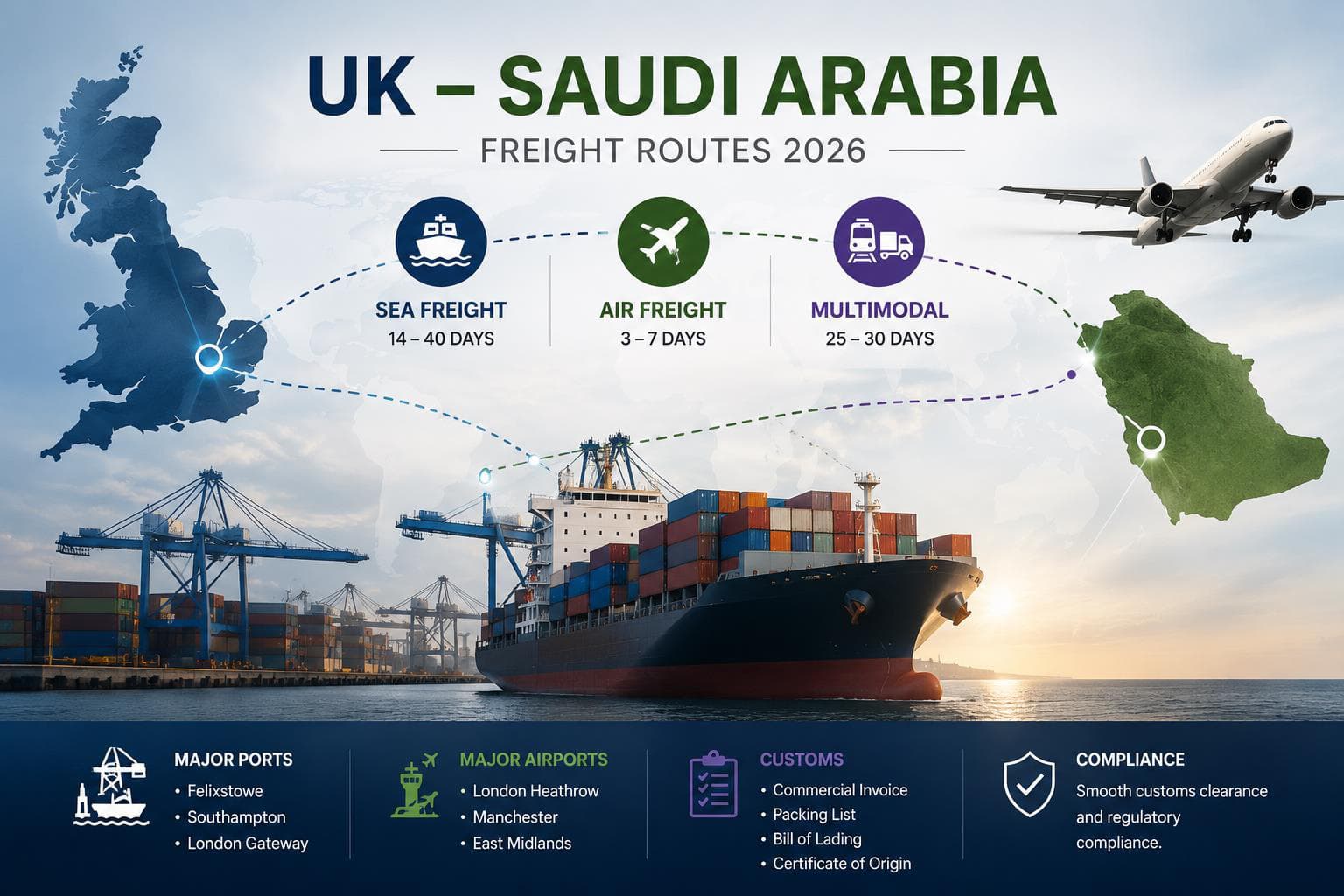
Main Freight Routes Between the UK and Saudi Arabia
There are three primary ways to move cargo between the UK and Saudi Arabia:
The right option depends on your cargo type, delivery deadline, budget and destination.
- Air Freight – Best for urgent and high-value shipments
- Sea Freight – Most cost-effective for heavy and containerised cargo
- Multimodal Transport – Combines road and sea transport for greater flexibility
Typical transit times by shipping method
- Air Freight: 3–7 days — best for urgent cargo
- Sea Freight (via Suez Canal): 14–20 days — standard container shipments
- Sea Freight (via Cape of Good Hope): 28–40 days — alternative routing during Red Sea disruptions
- Multimodal Transport: 25–30 days — project cargo and industrial equipment
Air Freight Routes
Air freight is the fastest shipping option between the UK and Saudi Arabia and is widely used for high-value or time-sensitive cargo.
Major UK Airports
- London Heathrow
- Manchester Airport
- East Midlands Airport
Saudi Arabian Airports
Typical transit times range between 3 and 7 days, including customs clearance.
- King Khalid International Airport (Riyadh)
- King Abdulaziz International Airport (Jeddah)
- King Fahd International Airport (Dammam)
Air freight is ideal for
Although air freight has higher transportation costs than sea freight, it offers faster delivery, reduced inventory costs and improved supply chain responsiveness. According to the International Air Transport Association (IATA), air cargo carries more than one-third of global trade by value, making it essential for time-critical international shipments.
- Pharmaceuticals
- Electronics
- Medical equipment
- Aerospace components
- Urgent manufacturing parts
Sea Freight Routes
Sea freight remains the preferred choice for businesses shipping larger volumes due to its affordability and ability to handle oversized cargo.
Most exports depart from
- Felixstowe
- Southampton
- London Gateway
Cargo typically arrives at
- Jeddah Islamic Port
- King Abdulaziz Port (Dammam)
- King Abdullah Port
The traditional shipping route follows
UK → English Channel → Mediterranean Sea → Suez Canal → Red Sea → Jeddah
Under normal conditions, transit times range from 14 to 20 days, making this the quickest sea freight route to western Saudi Arabia.
Route via the Cape of Good Hope
Due to ongoing security concerns affecting parts of the Red Sea, some shipping lines continue routing vessels around southern Africa.
The route follows
UK → Atlantic Ocean → Cape of Good Hope → Indian Ocean → Arabian Gulf → Dammam
This alternative route typically takes 28 to 40 days. While the journey is longer, it helps carriers maintain operational safety and schedule reliability during periods of regional disruption.
Businesses should confirm routing with their freight forwarder, as shipping schedules continue to evolve based on global maritime conditions.
Multimodal Transport
Multimodal shipping combines multiple transport methods under one logistics solution, usually involving road transport within the UK, ocean freight, and final inland delivery in Saudi Arabia.
Typical transit times range from 25 to 30 days, depending on the route and customs clearance.
This option is commonly used for
It offers a practical balance between cost, flexibility and delivery performance.
- Project cargo
- Heavy machinery
- Construction equipment
- Automotive shipments
- Industrial components
Customs Requirements
Successful shipping to Saudi Arabia depends on accurate documentation and compliance with customs regulations.
Businesses typically require
Saudi Arabia's Zakat, Tax and Customs Authority (ZATCA) oversees customs procedures and import compliance. Incorrect documentation or product classification may result in shipment delays or additional charges. Working with experienced customs clearance support helps ensure shipments move without unnecessary hold-ups.
Which Freight Route Should You Choose?
Choosing the right freight solution depends on your business priorities:
Working with an experienced freight forwarder helps businesses select the most suitable route while ensuring compliance with customs regulations and reducing supply chain risks.
- Commercial Invoice
- Packing List
- Bill of Lading or Air Waybill
- Certificate of Origin
- Harmonised System (HS) Codes — see our commodity codes guide for UK exporters
- Import permits (where applicable)
- Fastest delivery → Air Freight
- Lowest shipping cost → Sea Freight
- Heavy or oversized cargo → Sea Freight
- Project logistics → Multimodal Transport
- Balanced cost and speed → Multimodal Transport
Final Thoughts
The UK–Saudi Arabia trade corridor continues to offer significant opportunities for businesses across manufacturing, healthcare, retail, construction and industrial sectors.
While air freight provides the fastest delivery, sea freight remains the most economical choice for large shipments, and multimodal transport offers flexibility for specialised cargo.
Understanding current transit times, customs requirements and routing options enables businesses to plan shipments more effectively and build resilient international supply chains.
At Clarusto Logistics, we help businesses move cargo between the UK and Saudi Arabia through tailored air freight, sea freight and multimodal logistics solutions, supported by customs expertise and end-to-end supply chain management.
Frequently Asked Questions
What is the fastest freight route between the UK and Saudi Arabia?
Air freight is the fastest option, with transit times typically ranging from 3–7 days, depending on customs clearance and airline schedules.
How long does sea freight take from the UK to Saudi Arabia?
Sea freight generally takes 14–20 days via the Suez Canal to Jeddah. If vessels are routed via the Cape of Good Hope, transit times may extend to 28–40 days.
Which UK ports are commonly used for shipping to Saudi Arabia?
The main export ports include Felixstowe, Southampton, and London Gateway, offering regular container services to Saudi Arabia.
Which Saudi Arabian ports receive cargo from the UK?
Most shipments arrive through Jeddah Islamic Port, King Abdulaziz Port (Dammam), and King Abdullah Port, depending on the cargo's final destination.
What documents are required to ship goods to Saudi Arabia?
Typical documents include a Commercial Invoice, Packing List, Bill of Lading or Air Waybill, Certificate of Origin, HS Codes, and any applicable import permits.
Is sea freight cheaper than air freight?
Yes. Sea freight is significantly more economical for large, heavy, or containerised shipments, while air freight is better suited for urgent and high-value cargo.