
One Incorrect HS Code Can Affect an Entire Quarter's Revenue
One incorrect HS code can do more than delay a shipment. It can create repeated duty discrepancies, unexpected compliance costs and pressure on quarterly margins. Discover why classification accuracy matters in 2026 and five practical steps importers can take to reduce risk.
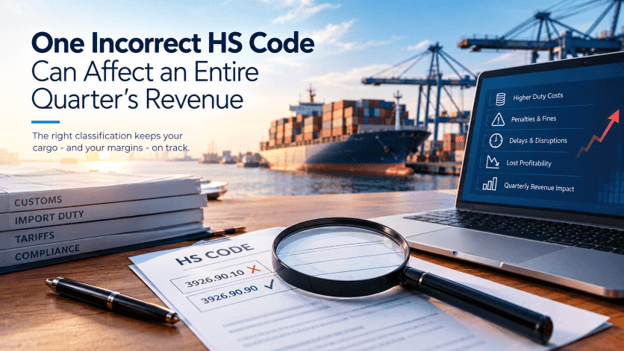
The Smallest Number Can Create the Biggest Cost
A shipment clears customs. The goods arrive on time. The invoice is paid. Everything appears to be running smoothly.
Then a customs review identifies one incorrect HS code.
What initially looks like a minor documentation error can reveal a much larger problem: duty calculated at the wrong rate, import VAT implications, unexpected compliance costs and similar errors repeated across hundreds of shipments.
For businesses importing regularly, the financial impact may extend well beyond a single consignment. It can affect margins, working capital and quarterly financial performance.
This is particularly relevant for UK importers in 2026. HMRC updated its guidance on customs civil penalties on 31 July 2026, while the Chartered Institute of Export & International Trade highlighted classification errors among the common causes of customs duty underpayments in February 2026.
The message for businesses is clear: HS code accuracy is not simply a customs requirement. It is part of financial risk management.
What Is an HS Code, and Why Does It Matter?
The Harmonized System (HS) is an internationally recognised framework used to classify traded goods. The World Customs Organization (WCO) maintains the system, which provides a common foundation for customs classification across international markets.
The first six digits are harmonised internationally, while individual customs territories can extend codes to provide more detailed product classifications.
