Introduction
In the landscape of 2026, the global marketplace has never been more accessible—or more complex. For UK businesses, the "straight line" from manufacturer to customer has evolved into a sophisticated web of digital checkpoints, environmental mandates, and geopolitical shifts.
If you are a business owner or a supply chain manager, you have likely asked: "How do I move my goods across borders without getting stuck in a bureaucratic nightmare?" The answer lies in understanding the modern evolution of freight forwarding. This guide serves as a comprehensive resource for laypeople and industry veterans alike, breaking down the "what," the "how," and the "who" of logistics in the current year.
What is freight forwarding in 2026
At its most basic level, a freight forwarder is a strategic architect for your supply chain. They do not physically own the ships, planes, or trains (those are the "carriers"); instead, they are the expert intermediaries who organize the entire journey.
Think of it like planning a complex international wedding. You do not own the hotel, the catering company, or the florist—but you hire a wedding planner to make sure everyone shows up at the right time, the legal paperwork is signed, and the budget does not explode. In the world of cargo, the freight forwarder is that planner.
Why the definition has changed in 2026
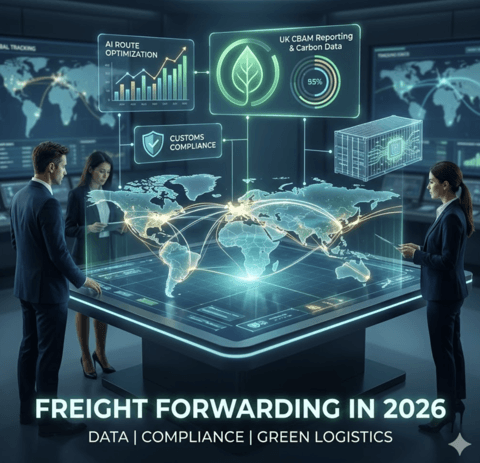
Traditionally, forwarders were "paperwork pushers." Today, they are data scientists. With the 2026 integration of AI-driven logistics, a forwarder's job is now to analyze massive amounts of data to predict port strikes, avoid weather-related delays, and optimize for the lowest carbon footprint.
Common questions people actually ask
Is a freight forwarder the same as a shipping line? No. A shipping line (like Maersk or MSC) owns the vessels. They are the "bus drivers." A freight forwarder is the "travel agent" who finds the best bus, handles your luggage, ensures you have the right visa, and finds you a taxi at the other end.
Why should you not go directly to the carrier? While large conglomerates might deal directly with carriers, most businesses benefit from a forwarder because of buying power. Forwarders bundle shipments from hundreds of clients, allowing them to negotiate "wholesale" rates that an individual company could never access. Furthermore, carriers move "port-to-port," while forwarders move door-to-door supply chain services.
What does a customs broker do? Customs is the number one reason for delays. A forwarder acting as a broker ensures your goods are assigned the correct HS Codes (Harmonized System). In 2026, with the UK's strict compliance rules, one wrong digit can result in your cargo being seized or fined 10% of its total value. Clarusto supports filings through the customs clearance service model.
The seven-step lifecycle of a shipment
To understand how your money is being spent, you need to see the "hidden" steps of the forwarding process.
Export haulage: The journey begins at your warehouse. A truck collects the goods and moves them to the forwarder's local origin warehouse.
Export customs clearance: Before the goods can leave the UK, they must be cleared. The forwarder submits the declaration through the Customs Declaration Service (CDS).
Origin handling: The goods are inspected, validated, and loaded. This is where consolidation (LCL—Less than Container Load) happens to save you money.
International transit: The "middle mile"—the movement via sea, air, or rail.
Import customs clearance: The "entry visa" where duties and taxes are calculated and paid to the destination government.
Destination handling: The container is unloaded at the port and transferred to a local distribution center.
Import haulage (the last mile): Final delivery to the customer. In 2026, this often involves electric or autonomous vehicles in UK "Clean Air Zones."
Navigating the 2026 UK regulatory landscape
For UK-based businesses, 2026 is a landmark year. We have moved into a highly regulated, digital-first environment.
The UK Single Trade Window (STW): A digital portal where all trade information is submitted once. Your forwarder must be technologically integrated to avoid manual data entry errors.
The UK Carbon Border Adjustment Mechanism (CBAM): You are now legally required to report the carbon emitted during the production of goods like steel and aluminum. A forwarder that cannot provide carbon reporting is no longer viable.
The Windsor Framework: Expertise in the UK Internal Market Scheme (UKIMS) is now mandatory to ensure trade between GB and Northern Ireland stays duty-free.
The benefits of professional forwarding
Cost efficiency: Through consolidation and rate negotiation.
Scalability: Enter a new market (like the US or Middle East) overnight using your forwarder's existing network.
Risk management: From cargo insurance to rerouting shipments during geopolitical unrest.
Visibility: Real-time dashboards showing temperature, tilt, and GPS location.
Why choose Clarusto Logistics
In a sea of logistics providers, Clarusto Logistics has spent 2026 redefining what a "partner" looks like.
Master of the heavy lift: Many forwarders avoid "difficult" cargo. At Clarusto, we specialize in project logistics. Whether it is massive industrial turbines or delicate medical technology, our engineering background ensures cargo is moved with mathematical precision. Explore project cargo and ocean freight when shipments are oversized or require specialist equipment.
The digital vanguard: Our proprietary platform integrates directly with the UK Single Trade Window, offering automated customs filings, real-time AI route optimization, and instant CBAM-compliant carbon reporting.
Human-centric service: When a storm hits or a border closes, you do not want a chatbot—you want a Clarusto expert. Our "boots on the ground" philosophy means we have local experts in every major trade hub.
Conclusion: Your gateway to the world
Freight forwarding in 2026 is no longer a "back-office" function; it is a competitive advantage. The ability to move goods faster, greener, and with fewer legal hurdles is what separates market leaders from those who struggle.
Is your supply chain ready for the rest of 2026? Get a quote from Clarusto Logistics for a bespoke logistics audit and see how we can turn your shipping challenges into your greatest strength.
Sources and compliance references
HMRC Technical Specifications for the UK Single Trade Window.
UK CBAM Reporting Standards (2026).
WTO Annual Report on Trade Digitalization.
BIFA Standard Trading Conditions 2026.
Frequently Asked Questions
What exactly is the UK Single Trade Window (STW)?
The STW is a central digital gateway that allows traders and their freight forwarders to provide all data required by various government agencies (HMRC, DEFRA, Home Office, etc.) through a single submission. Instead of logging into multiple portals to handle customs, health certificates, and safety declarations, you submit your data once to the STW, and the system distributes it to the relevant departments.
How does the STW differ from the old Customs Declaration Service (CDS)?
Think of the CDS as the "engine" for customs entries, while the STW is the "dashboard" for the entire border experience. While CDS focuses specifically on taxes and duties, the STW encompasses everything—from SPS (Sanitary and Phytosanitary) checks to carbon reporting data—linking them all to a single shipment ID to reduce redundancy.
Does my business need to register for the STW directly?
While businesses can access the portal, most UK enterprises find it more efficient to operate through a technologically integrated freight forwarder. At Clarusto Logistics, our systems are linked via API to the STW, meaning when we process your shipment, we automatically populate the STW requirements on your behalf.
Will the STW eliminate physical border checks?
No, but it significantly reduces "administrative friction." Because the government receives all data upfront in a standardized format, risk assessments are completed faster. This means "Green Lane" goods move through ports without stopping, while physical inspections are targeted only at high-risk cargo.
How does the STW help with 2026 CBAM reporting?